Related Content
•
Give to the CoSIDA 60 for th 60th Campaign — Honor someone who made a difference in your career and support CoSIDA scholarships
This feature is one of the many profiles we are doing to showcase our diverse CoSIDA membership during 2017 CoSIDA Membership Recognition Week. To see all the feature stories,
please click HERE.
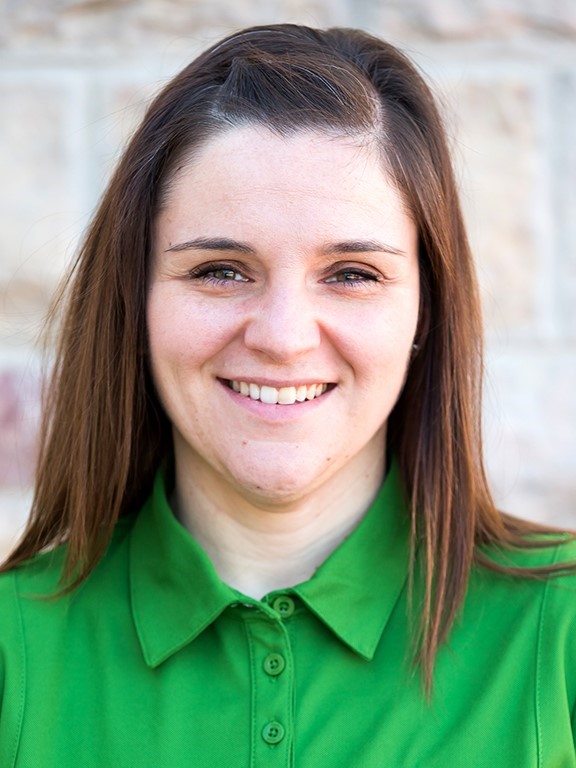
Nicole Betker: University of Saskatchewan
Sports Information Director
 by Nathan Yacovissi, University of Dallas Sports Information Manager
CoSIDA Recognition Week Committee member
Nicole Betker
by Nathan Yacovissi, University of Dallas Sports Information Manager
CoSIDA Recognition Week Committee member
Nicole Betker serves as the Sports Information Director at the University of Saskatchewan, a member of the Canadian U Sports national association. Geographically, the province of Saskatchewan’s southern border are the U.S. states of Montana and North Dakota.
Betker has been part of the Saskatchewan staff since September, 2007. The campus is located in the heart of the city of Saskatoon, on South Saskatchewan River. With a student population of 21,000, it is one of Canada’s top research universities.
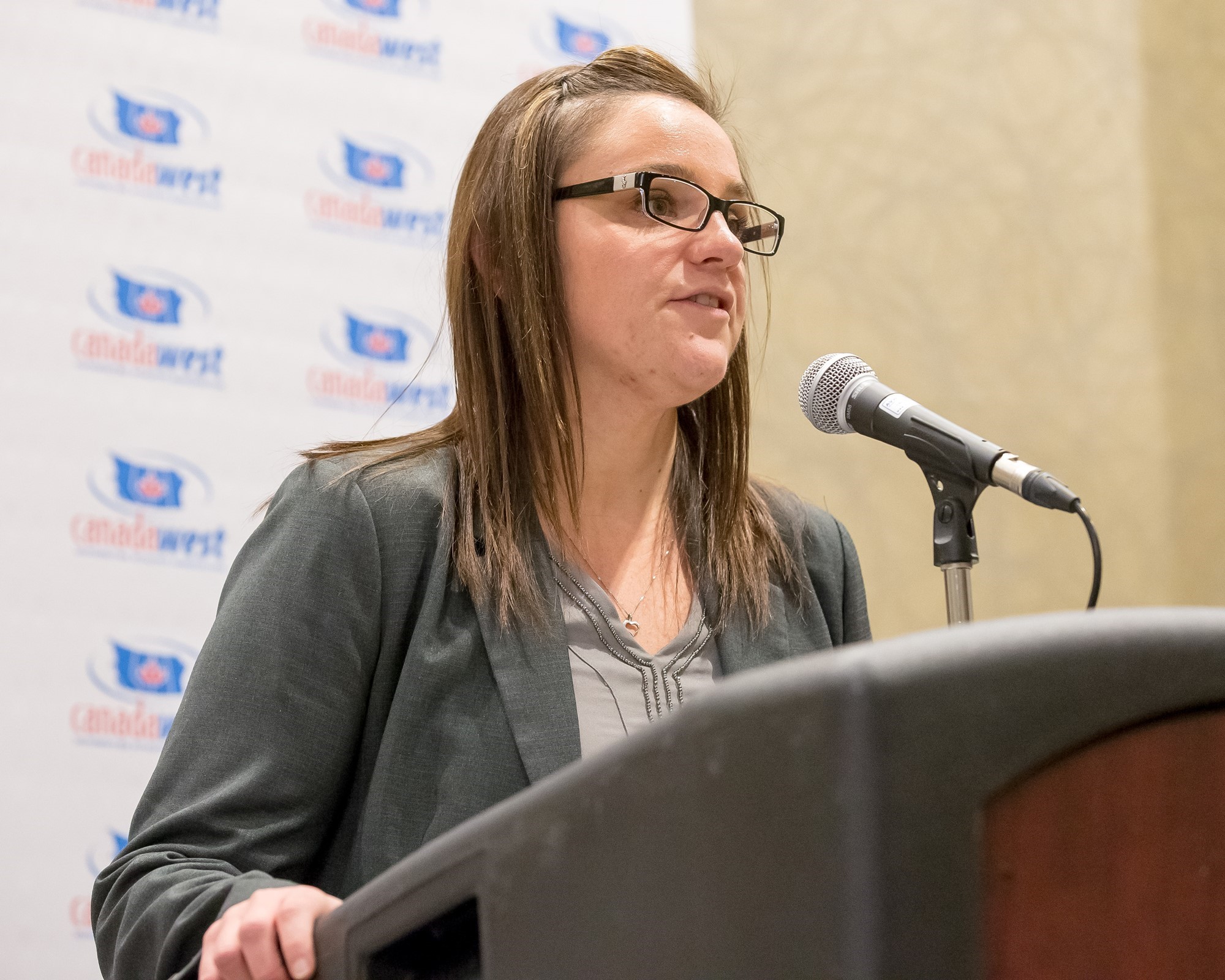
Betker has been involved in numerous Canadian and CoSIDA committees where she has held many leadership positions, spending time on the Canada West Sports Information Director Committee as chair (2012-14), the Canada West Marketing Committee and U Sports Marketing Committee. Her volunteer CoSIDA roles include serving on the Academic All-America Committee and CoSIDA’s College Division Management Advisory Committee (CDMAC).
A native of Regina, Betker earned her journalism degree at Ryerson University in Toronto. She established her athletic communications career early on while in Toronto, working for Maple Leaf Sports and Entertainment Ltd., at the Air Canada Centre home of the Toronto Maple Leafs, Toronto Raptors and Toronto Rock. It is probably no surprise that she is a huge fan of the Toronto Maple Leafs & Blue Jays.
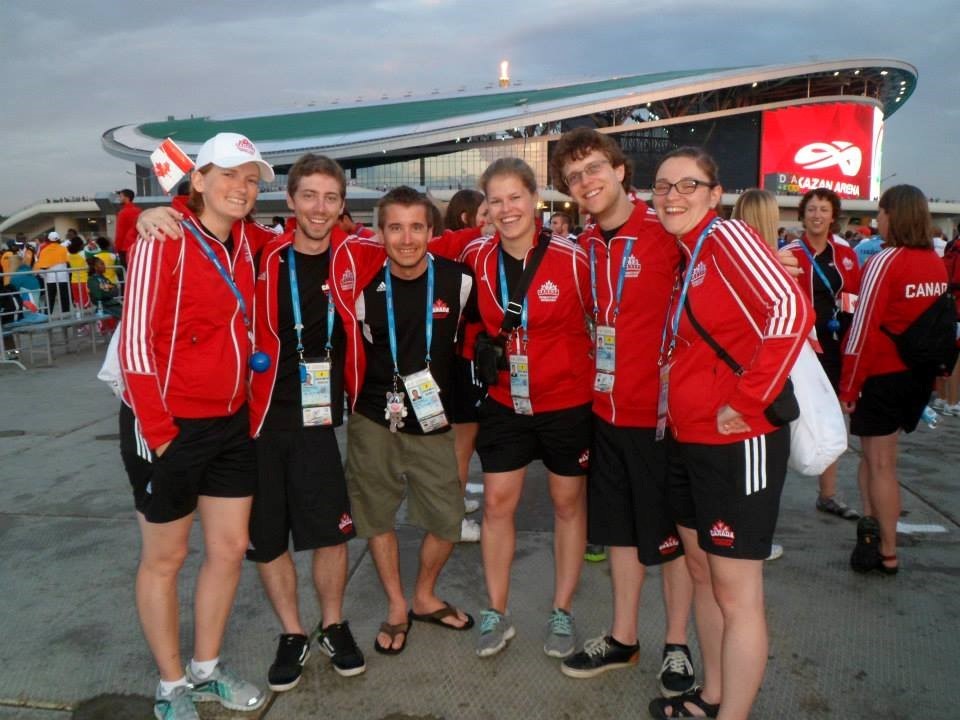 Betker and the 2013 World Universiade communications
team at the closing ceremonies in Kazan, Russia.
Betker also represented the 29th World Summer Universidad in Kazan, Russia as a member of the communications team and also worked at the 2005 Canada Games.
Nicole balances the demands of being a one-person SID office for 15 Huskie teams with being a young mother. She talks about that and her experiences as an athletic communications professional below.
Can you share your experience being on multiple committees and how you balance that with your current position?
Learning is extremely important to me. One of my favorite quotes is by Ghandi: “Learn as if you will live forever.”
Without experiences on committees, I feel like I wouldn’t be as successful as I am in my career. The balance of learning how to work with new people and manage my time has been so rewarding and set me up for success. I’ve always been a leader and had the instincts to be a leader and to give back. Being on committees has always seemed like a natural fit to me.
What challenges have you faced during your time at Saskatchewan? How have things changed in 10 years covering the Huskies?
I am sure my challenges are the same as many SIDs in North America – time and resources. With one of me and 15 successful teams, there isn’t always time to ensure everyone gets my equal attention or the extras that they may deserve – particularly at extra busy times of the year.
When I started as an SID in 2007, the world was a little simpler. Statistics, media relations, writing and updating a basic website were the top priorities. Now, there is so much more. All of the above still applies but add in social media, video, webcasting. The changing landscape of the mass media has also forced me to create our own news and become our own source.
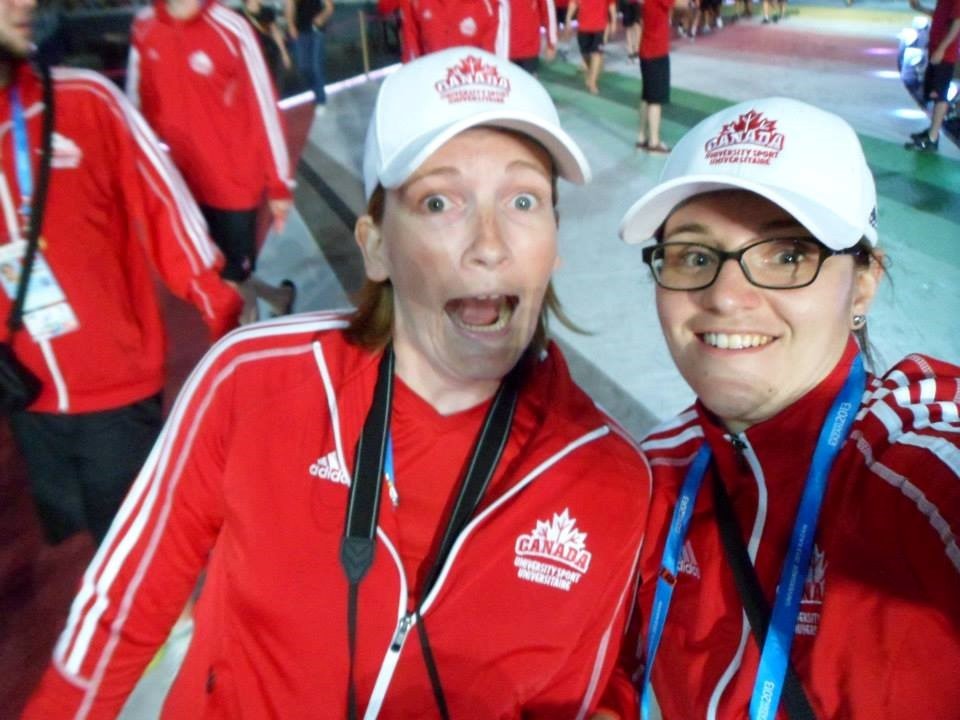 Nicole Betker with physiotherapist Rhonda Shishkin at a
Canadian women’s basketball game at the 2013 World
Universiade in Kazan, Russia.
Can you describe your experience covering the 2005 Canada Games?
As a young reporter this was valuable experience in setting me up for success in my journalism career. The event was hosted in my hometown giving me a feeling of comfort with the venues and some of the volunteer communicators I was working with. To be able to share the stories of young athletes having success, gave me my first taste and realization that this is whom I wanted to cover and work with moving forward in my career.
Tell us about your experience representing Canada at the World Summer Universidad in Kazan, Russia?
I can’t begin to describe the impact that this experience had on my career. I would put this at the top of the list of my professional achievements. As an armchair athlete all my life, the experience of wearing my countries colours and walking with some of the greatest current and future Canadian athletes in the opening and closing ceremonies is an experience I will never forget.
Working in another country to promote my athletes alongside my fellow Canadian SIDs helped me grow as a communicator. Barriers such as language, jargon and time change made me approach game reporting differently.
 Having been to multiple CIS (now U Sports) national championships, is there a particular moment that stands out the most to you?
The wins most easily standout, particularly the men’s basketball national championship in 2009-10. As the underdog team at the eight team tournament, it was an unexpected surprise.
But professionally, it is the losing that stands out. It’s not easy to lose in the championship game on national television. These moments have helped me grow as I’ve had to deal with disappointed and obviously upset athletes and coaches – some who have just played their final game. I find it a teaching moment. Speaking in difficult situations is a life lesson that our young athletes will eventually understand as they move on in life.
What advice would you give to a young professional looking to enter the athletic communications field? What they should know about the job, what skills they should bring to the position?
Working with student staff is one of my favorite aspects of my job. I like sharing my knowledge and setting them up for success no matter what their future path may be. I am proud to say that three of my former student assistants became colleagues of mine in my department.
I feel the main ingredient to be successful in the SID world is to realize that it is not just a job, but a lifestyle choice. It is the honest truth that sacrifices need to be made by yourself and your family for you to do the job and the people surrounding you must support your choice. You need to love what you do to do it.
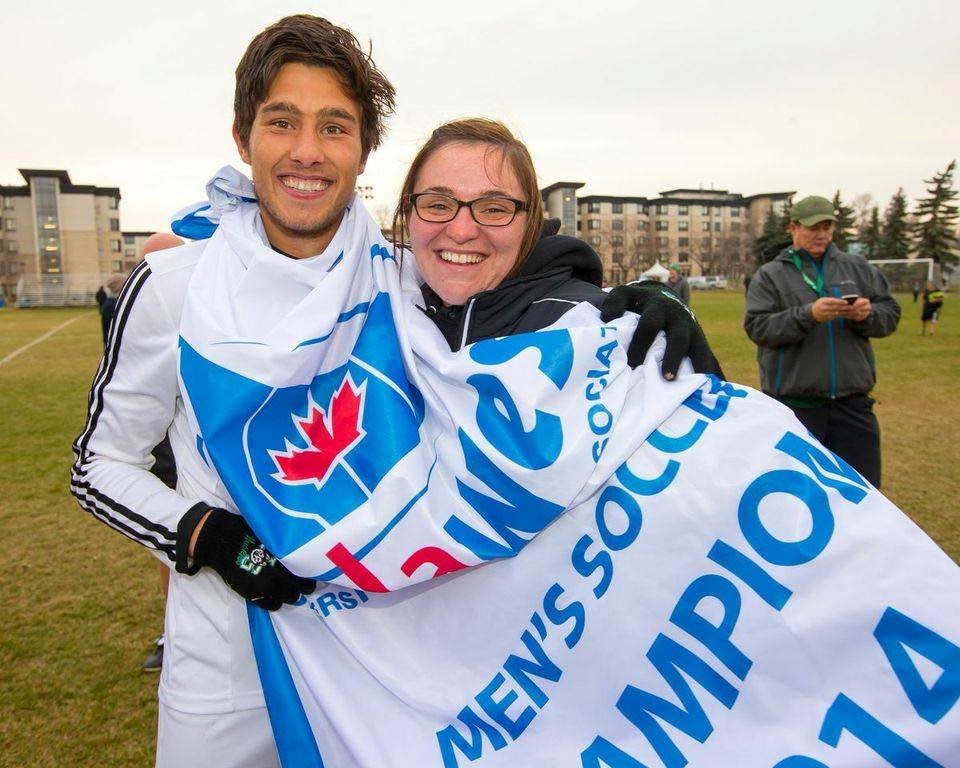 With former Saskatchewan Huskie standout and current
soccer professional Jordian Farahan after the 2014 Canada
West men’s soccer championship.
In the current landscape of the athletic communications role, I don’t think there is one specific skill set that they need to have. In Canada, SIDs come from a variety of backgrounds – print journalism, broadcast journalism, public relations, marketing. Each one is successful at a specific area since the SID needs to wear a variety of hats at one time.