Related Content
•
CoSIDA Membership Recognition Week is Nov. 7-13
•
Learn more about WoSIDA at: CoSIDA.com/WoSIDA
•
Previous Women to Watch Features: Denise Archetto, Stonehill |
Stephanie Dutton, NEAC | Zekeya Harrison, Tennessee State | Kris Petersen, Penn State | Mary Beth Challoner, Toronto | Jolisa Williams, Shaw | Jill Guise, John Hopkins | Natalie Davis, Co-Lin | Sammi Wellman, California Baptist | Jenna Willhoit, Dayton
 WoSIDA Women to Watch: December 2018
Monyae Williamson, Assistant Athletic Director for Athletic Communications
Western Illinois University
by Barb Kowal – CoSIDA, Director of Professional Development and External Affairs
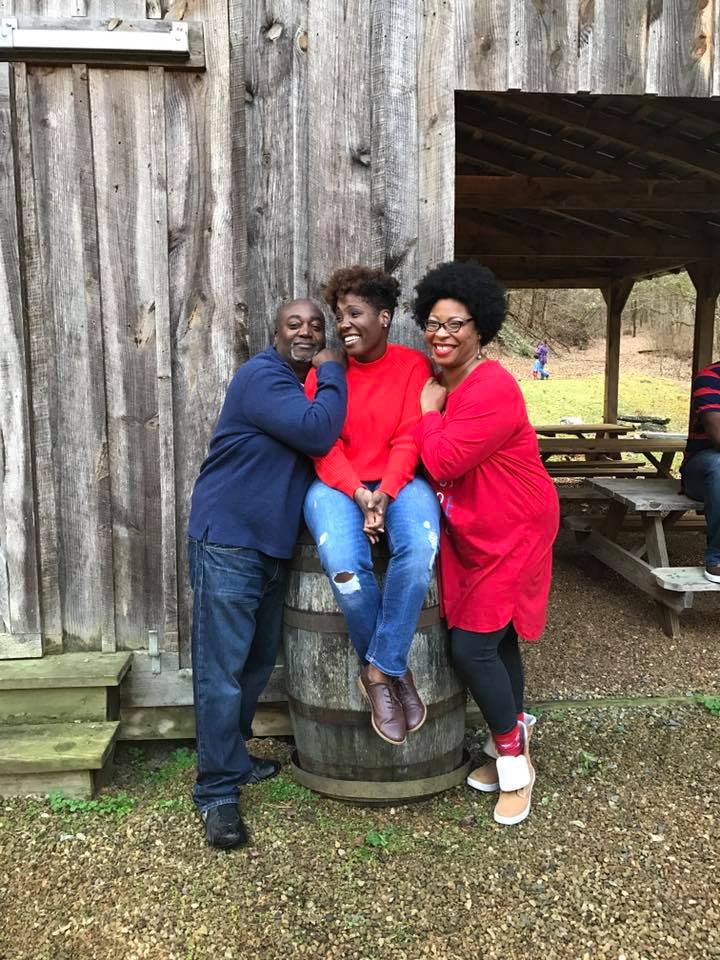 Monyae with her father Rayando and mother Desiree.
Less than a year ago, Monyae Williamson left Jacksonville University in Florida after a five-year tenure as director of media relations, and embarked on a new position 1,000 miles away in Macomb, Illinois as she joined the Western Illinois University Athletics Department.
Monyae with her father Rayando and mother Desiree.
Less than a year ago, Monyae Williamson left Jacksonville University in Florida after a five-year tenure as director of media relations, and embarked on a new position 1,000 miles away in Macomb, Illinois as she joined the Western Illinois University Athletics Department.
Williamson is WIU’s Assistant Athletics Director for Athletic Communications. Her staff consists of a creative director (David Vallandingham), a graduate assistant (Danny Frey), an intern (Matthew Hutchison) and a student videographer (Josh Hartsook) and together they oversee the publicity and promotion of the 19 Leatherneck athletic teams and their social accounts. The teams compete in the NCAA Division I Summit League and the Missouri Valley Football Conference.
Williamson is the principal contact for football, baseball, cross country, track and field, volleyball, women's basketball, swimming and diving and the WIU Athletics Hall of Fame.
Below, she talks about what drives her as an athletic communications professional, advice to others on being an ethnic minority female in the profession, her work on the CoSIDA Recognition Week writing sub-committee, what it meant to be a NCAA Inclusion CoSIDA Convention Grant recipient, her love of singing, and shares her insights on good storytelling, along with so much more.
In 140 characters or less, tell us who you are and how you got to where you are today.
MW: I’m a fun-loving, positive-energy creative with the coolest job on Earth. For some reason, people pay me to watch sports.
And to elaborate: I wouldn’t be who I am or where I am without God and the support of my family and friends. My parents (Rayando and Desiree) sacrificed everything so that I could be the first in our family to graduate from college, and they are the driving forces behind my success.
You are approaching your first year anniversary at Western Illinois, marking one year at WIU in January. What's this first year been like as an Assistant AD/department director at Western Illinois? Any particular initiatives or achievements you're most proud of?
MW: This has been an incredible transition. I can’t believe it’ll soon be a year; it feels like I just got here, but it has all been fun and different. Not only am I adjusting to a new city and region that I’ve never been to before, but I’m also adjusting to new responsibilities. I couldn’t be more thankful that our former athletic director Matt Tanney and our current interim AD Danielle Surprenant allowed me to join the senior administration here at Western Illinois, and for also trusting me with sport oversight.
You have mid-south, southern roots as a native of Baltimore and as someone doing undergraduate work in North Carolina (High Point) and master's work in Florida (Jacksonville). What's it like to move to the Midwest?
MW: I lived in Florida for so long (2013-17) that I forgot what the cold felt like! The weather here has been the biggest adjustment. It’s kind of crazy to believe that I haven’t yet bought a winter coat and many of my pants are capris, so they stop before my ankles. I really need to invest in winter wear but other than that, the Midwest has been fun! I’ve had the opportunity to visit states that I have never been to before and Portillos’ Italian beef is one of the best things I’ve ever eaten in my life.
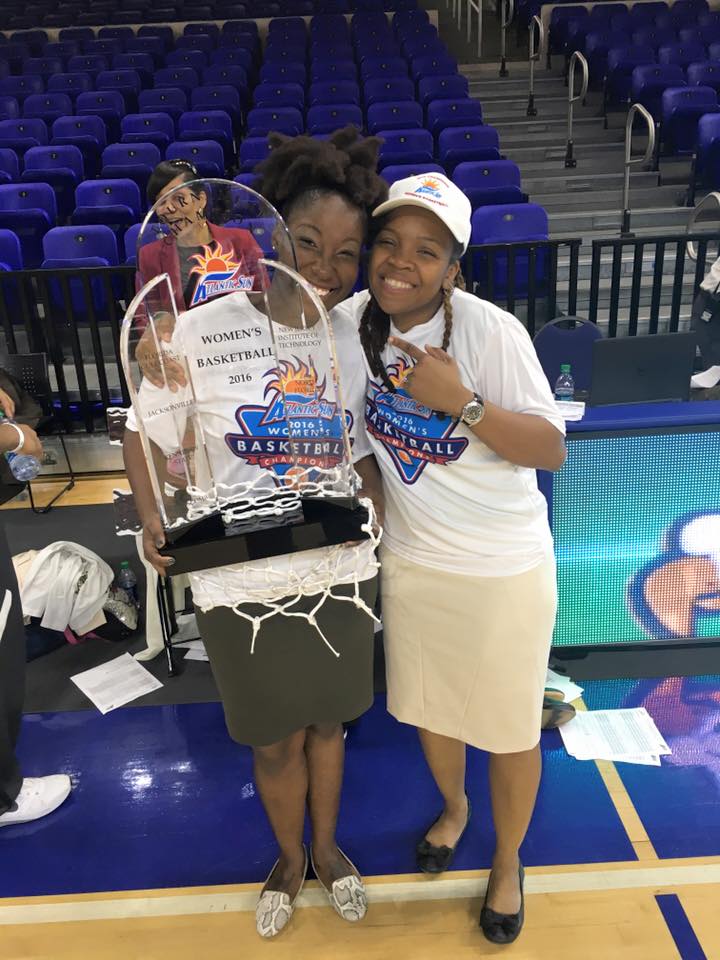 Williamson and former Jacksonville head coach Yolett
McPhee-McCuin after winning the program's first ASUN
Conference title. McPhee-McCuin currently is the new head
coach at Ole Miss and the first black head coach hired
at the University.
You are one of the few ethnic minority females leading an athletic communications department – and, also one of the few being the primary football contact. What are some strategies that you can share with other females about climbing the professional ladder? How would you advise others to overcome hurdles and obstacles?
MW: As a woman, in a predominately male-dominated field, I have found that it’s so important for us to lift each other up. When climbing the professional ladder, we have to share our successes and failures to help the next person.
As a black woman in this field, the pool is even smaller. Black SIDs represent less than five percent of the entire athletic communications profession. I’m a small representation of what giving someone a chance looks like. Women are just as qualified to cover football, men’s basketball, and baseball, so my advice is to seek those opportunities and when you get them, be so great that a woman in that role is no longer a shock but the norm.
How do you define creativity?
MW: Creativity is art in all of its various forms, and the best part of being an SID. We get to make art on a daily basis through our writing, photos, and video, and use it to connect with people.
What’s one trend in athletic communications that you are a fan of?
MW: I love searching online to see what my peers are doing, and I try to incorporate several of those at Western. In the last year, we’ve found that personalized GIFs are a huge hit with our student-athletes and this year, we’re really pushing for a more personalized touch in everything we do whether it be feature stories, graphics, or video.
The last two years, you've volunteered your time to be a feature writer during CoSIDA Recognition Week. This necessitates carving out time in your own schedule to step away from covering your own sports teams and student-athletes to interview and coordinate photos, etc. of numerous CoSIDA members ... Why is this volunteer position important to you?
MW: Working with the Recognition Week committee has allowed me to sharpen my skills and network with incredibly talented individuals. How cool is it that I had the opportunity to serve alongside the president of CoSIDA (current president Rob Knox of Towson)! Writing is also my way of saying thank you to a field that has given me so much. I truly love what I do, and a lot of amazing SIDs took the time to mentor me, so why not take a little time to showcase the rock stars in our field?
What satisfaction have you gained from doing Recognition Week writing and outreach?
MW: Writing for Recognition Week has been a lot of fun, and I most enjoy it because it forces to get out of my comfort zone a little to interview colleagues who I’ve possibly never met. Everyone has a story, and it’s been fun sharing them.
In your hiring announcement, I read where you have a "commitment to storytelling;” you've also entered the CoSIDA Fred Stabley Sr. Writing Contest and had your work recognized. Talk about the importance of being a good storyteller in athletic communications. Any tips/advice you have for those who might struggle or need some guidance in how to tell a good story and what to tell in that story?
MW: A former boss, Jim Nasella of Jacksonville, really sparked my love for storytelling. I remember telling him I was thinking about leaving the field and searching for a job that would make a difference. He said something to the effect of ‘You may not be Mother Theresa, but you have the opportunity to positively impact the lives of these student-athletes by sharing their stories. When they look back at their time here, they’ll have these mementos and will cherish them for the rest of their lives.”
Jim set the standard of one feature story for every sport, and I’ve continued that tradition with each of my staffs. These men and women are so much more than just their play!
“At the CoSIDA Convention last year, one of the presenters said ‘humanize before you analyze’ and that’s the best advice I’ve ever received. Take the time to get to know your student-athletes, chat with them outside of practice and ask your coaches for interesting storylines that will make for a great feature.”
What’s an example of one way in which CoSIDA membership has positively impacted your career?
MW: Last year, I was lucky to be chosen for the NCAA Inclusion CoSIDA Convention Grant which allowed me to go to the convention for the first time and later in the summer, also visit the NCAA national office for networking opportunities and learning about the NCAA. I learned so much from those visits and couldn’t wait to get back home to apply all the nuggets picked up.
The grant also paired me as a mentee with (Assistant AD for Sports Information) Bryan Boettcher from South Dakota. He was a huge help in preparing me for my interview at Western, and it’s pretty cool that we’re in the same conference now.
How did you enter the athletic communications profession?
MW: I was looking to gain experience and the High Point sports information department provided that. I will forever be grateful to Jon Litchfield, Erika Powell, and Joe Arancio. I wasn’t the best student worker for them, as my schedule was packed with campus activities and two other jobs, but they were my first introduction to this field.
I remember cutting out game write-ups from the local newspaper every week, updating player bios and filming game highlights and postgame interviews. In the second semester of my senior year, when I finally decided this is what I wanted to pursue as a career, they were really supportive.
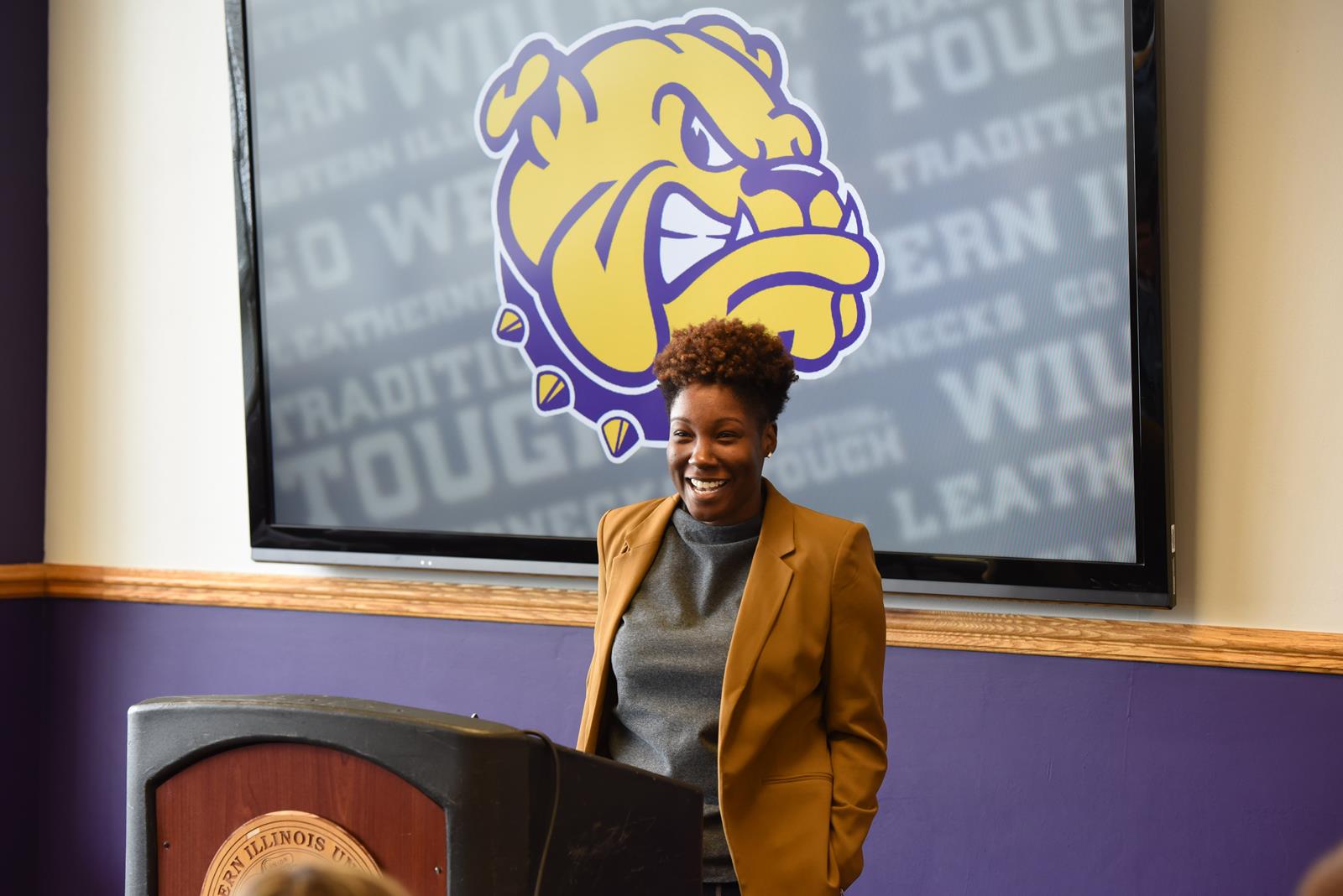 One of the first photos of Williamson taken after she
was announced as the new Western Illinois Assistant AD
for Athletic Communications in January of 2018.
Who were the people who encouraged you at the beginning of your career - and if they are not your mentors, who are your mentors?
MW: I’ve met a lot of awesome people in this field. Todd Vatter and Alex Keil hired me at Jacksonville, and to this day, whenever I have a question, they are the first to be buzzed. Those two gave me my first shot, and Todd really took a chance on me, hiring me as his assistant director just one year after my internship.
It’s funny that Alex left Jacksonville, Fla. as well, to work in Jacksonville, Ill. He currently works at Illinois College, and so we get to hang out sometimes and bounce ideas off of each other.
Outside of athletic communications, my former Jacksonville women’s basketball coach Yolett McPhee-McCuin has been a great mentor. She has taught me a lot as it relates to being a young black professional. I’m in awe of her successes over the last few years, and she is now head coach at Ole Miss. It’s because of her that I wanted to pursue the opportunity at Western Illinois.
What’s the project or campaign that you’re proudest of? Why?
MW: I’m most proud of a piece that I wrote at Jacksonville University about the 1969 men’s soccer team and its undefeated season. What started as a short write-up for an upcoming reunion led to an in-person interview, which led to several members of the team sending pictures and insight into the season. The gathering was delayed a year due to a hurricane, and so I started the feature but never posted it. A year later, many of them made their first trip to campus in years, and it was so much fun meeting them. That is the story that won an award in the Fred Stabley Writing Contest.
Click here to read the story.
Where do you get your news?
MW: My phone sends random alerts from different news sources, but usually, I get my news from Twitter. It’s the definition of convenience, especially since I spend so much time there already.
On your LinkedIn profile, you list "experience with political research" as one of your skills. Can you elaborate on that?
MW: While in undergrad at High Point University, one of my campus jobs was as supervisor with the Survey Research Center. The SRC surveys people in North Carolina about various public affairs issues and we publish those findings. I really enjoyed doing that and was also tasked with special projects related to the NC elections.
Once you leave the office and work behind, we would find you doing what?
MW: I meet up with my trainer three days a week after work. It’s kind of weird, but around 10 p.m., I’m back at the gym to expend my last bit of energy. Between those times, I’m either napping or catching up with friends. I don’t watch sports as often as I used to but enjoy playing a good pickup game of basketball and am a huge fan of music. I saw Beyonce last summer, and my life has forever been changed.
If your WIU job gave you a surprise three day paid break to rest and recuperate, what would you do with those three days?
MW: I’m almost ashamed to say this, but one of those days will include a lot of reality TV and sleeping. Bravo, VH1 and the Food Network stream all of my favorite shows, but if this vacation is during the holiday season, without a doubt, there will be a Hallmark movie marathon.
I’d also probably attempt to cook something I’ve watched on Chopped, and it’ll be under- seasoned as my meals often are - but that’s what’s for dinner all three days.
What are your favorite apps? What app can you not believe someone hasn’t made yet?
MW: MyMedia is the best app. It allows you to save video from Twitter and adds it to your camera roll in high-quality.
Someone should create an app where your laptop types your thoughts for you in perfect AP-style writing. That would make game previews so much easier!
Do you have a secret talent; if so, what is it?
MW: I wouldn’t say it’s much of a secret! If you’re around me long enough, you’ll hear me singing or humming anything from my grocery list to Beyonce. I sang all through college in a professional choir during the summer and in the High Point Chamber Singers. In my senior year, I actually got to go on a choir tour to Italy.
Future goals and plans, career-wise?
MW: In the next few years, I plan to pursue a doctorate in sport management so I can teach at the collegiate level.
You show this quote in your Facebook page intro: "No, I do not weep at the world—I am too busy sharpening my oyster knife." – ZNH. What's the story behind this and why this quote?
MW: That quote is one of my favorites from the essay How It Feels to Be Colored Me by Zora Neale Hurston. She was born in the late 1880s, the granddaughter of slaves, born and raised in the South and despite the times, she exuded a lot of pride in herself and her blackness. For several years, that quote served as a reminder for me to do the same.