Related Content
•
2020 Special Awards Announcements and Features
•
#CoSIDA2020 Virtual Convention Home
•
Past 25-Year Award Recipients
Ricky Hazel – Stetson University, Associate AD for Communications/Licensing & Branding
CoSIDA 25-Year Award
by Chuck Landon – Herald-Dispatch (Huntington, West Virginia) sports columnist
There is nobody in the history of COSIDA, who made the move into sports information for the same reason as
Ricky Hazel.
Nobody.
In 48 years of covering collegiate sports this writer certainly never has heard the like.
Here’s how it all began.
Hazel, who is now at Stetson University in Deland, Florida started out — again, somewhat uniquely — as a sportswriter. Although he graduated from Alabama with a degree in broadcasting along with his classmate Rece Davis of ESPN fame, Hazel’s first job was as a sports writer at a little newspaper in Cedar Town, Georgia.
“I started out at a little weekly paper,” recalled Hazel. “I was in Cedar Town for just a few months. Then, I moved to Alexander City, Alabama, and I was sports editor there. I did the daily paper in Alexander City and the little weekly paper down the road, Dadeville.
“And, then, I was also doing a little radio on the side, trying to keep my finger in broadcast because that's really what I wanted to do. But you're got to take the job that keeps you fed and keeps a roof over top your head.”
Like most media members, Hazel learned that lesson of life early.
"So, I worked there in Alexander City,” he continued, “then I got a chance to go to Corinth, Mississippi, as the sports editor there. It was a New York Times chain newspaper. It was Buford Pusser country.
“I spent about three years there and, then, got the sports editor's job in Meridian, Miss. It was a little bigger newspaper — seven days a week and I actually had a couple of assistants.”
That’s where it happened.
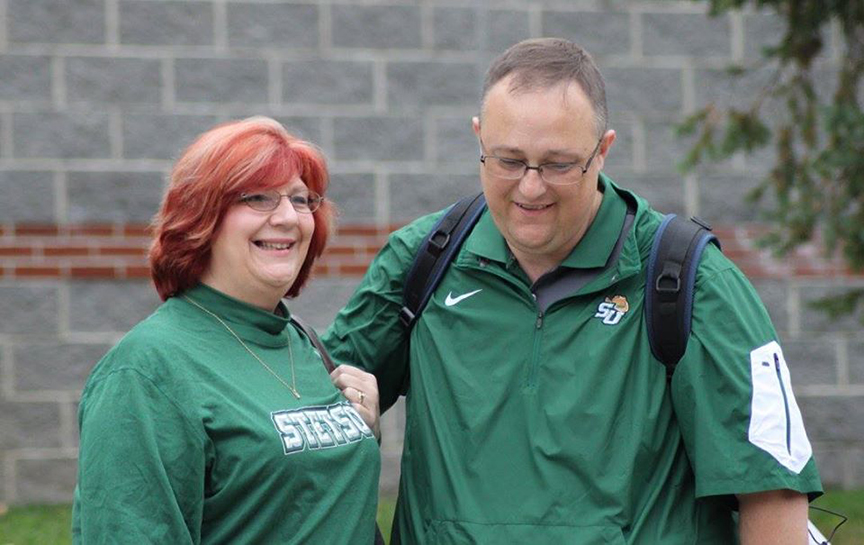 Ricky Hazel with wife Joan in 2015.
Events near Meridian actually changed the course of Hazel’s life.
"I always tell this story how I decided to get out of the newspaper business,” said Hazel, warming to the task. “The Star was an afternoon paper during the week and a morning paper on the weekends.
“So, that meant Fridays were 4 a.m. to put out the Friday paper and back Friday night to put out the Saturday morning paper. Those were double-shift days. Right then, we were doing all the writing, laying out the pages, doing the agate pages and taking the pictures — all of it.
"So, I think it was December of '92, I guess — '92 or '93. I had been in the office that morning and put out the Friday paper. Usually, on Fridays I tried to go get a nap during the day, but for whatever reason this Friday I didn't get to do that.”
That missed nap was the game-changer. It became the crux of Hazel’s career.
“I went out that night to Philadelphia, Miss., to cover Philadelphia and Schobert Central high school basketball,” recalled Hazel. “And, then, I would have to drive back to the paper afterwards, write my story and put the paper out.
"I fell asleep at the wheel driving back to Meridian, which was about 20 miles. I rolled my (pickup) truck. I'm laying in the truck and the truck is on its side in the middle of the road and cars are just driving around and not stopping to help.
“Oh, yeah, it was really nice. So, I was sitting there and you have this epiphany. The guy who had been sports editor there before me, he had almost been killed in a car wreck coming back from an event. The guy who had been sports editor in Meridian before him was killed in a car wreck.
“And I thought, 'You know what? I think it's time for me to do something else.' "
Bingo.
Karma didn’t have to smack Hazel upside the head to get his attention.
"I had covered a couple Southern Miss games when I worked in Meridian,” explained Hazel, “so I reached out to Regiel Napier, who was the SID, at Southern Miss and I said, 'Hey, I'm looking to make a change, do you have anything? Do you know of anything?' And he said, 'I'm going to have a graduate assistant spot open in May, would that be of interest?'
“And I said, 'Sold!' “
Hazel said hello to the rest of his life.
"So, I went to Southern Miss as a graduate assistant,” he said. “Joan and I were already married. She had to work to support us because I was working for peanuts and going to school. I got my master's in three semesters.
“Regiel kept me on. He created a position for me and kept me there and I stayed there until 1999 when I was at the CoSIDA convention in Orlando, Florida. They always have the career development and job seekers session as part of the convention.
“I saw the job opening for Marshall University. So, I thought I'd stick a resume in there. I needed the practice of getting interviews, and thought, maybe I'll get an interview.”
Little did Hazel realize that would be the beginning of four of the most memorable years of his life.
"I had no expectations of getting the job,” he said. “The SID was leaving and they had Chad Pennington (star quarterback) there, so somebody had to come in and take over.
“I interviewed for the job and was offered the job, then I went back to Southern Miss. We had bought a house and we were happy in Hattiesburg. I was making $20,000 a year as the assistant at Southern Miss, so I went to the department leaders. They could not match the Marshall offer, so we went to Marshall.”
He was bound for Huntington, West Virginia.
"What I did during those four years was run Chad Pennington's Heisman campaign and Byron Leftwich's deal and all the national attention we got with the Leftwich bobble head,” said Hazel. “We made a $50,000 profit on Byron's bobble head. I might be the only person who ever ran a Heisman campaign and turned a profit.
"During this, they had promoted me to assistant athletic director, without a raise. I went into the AD’s office after that year was over and said, 'Look, here's what we've done. Here's what we have accomplished.' But, that (raise) didn’t happen. So, I left without a job. It was a great four years. I learned so much during my time there. But I also learned that I won’t deal with that, won’t (compromise)."
And he never has since. Not at Alabama A&M, not at Troy and, now, not at Stetson.
And who would have guessed the 55-year-old Hazel’s illustrious CoSIDA career would have born behind the wheel of a pickup as a sleepy sports writer?
"I figured I had to do that out of self-preservation," laughed Hazel.
It was literally a life-changing decision for Ricky Hazel.
But he still drives a pickup.
Gallery: (6-30-2020) Ricky Hazel, 25-Year Award