Related Content
•
CoSIDA.com/CoSIDA360 Archive
This story is part of our May 2022 CoSIDA 360 package, to view more stories,
click here.
The Academy Life
Troy Garnhart of Air Force, Derick Thornton of Army and Scott Strasemeier of Navy share what makes their jobs special as SIDs at Division I military institutions.
by Will Roleson – CoSIDA Associate Executive Director @wroleson
Among the nation’s 358 NCAA Division I institutions, three stand unique.
The United States Air Force Academy, the U.S. Military Academy and the U.S. Naval Academy all compete at the highest collegiate level in athletics while developing young men and women into military leaders.
Each of the campuses is simultaneously a military base and a university campus. On one hand, their student-athletes (and all students) are 18-22 year-olds like any other college. But they’re also students who have been appointed to the academies and who have multi-year military commitments to fulfill after graduation.
All those combine to make the job of the academies’ athletics communications staff at least a bit different than those at other campuses.
Below are Q&As with the sports information directors at Air Force, Army West Point and Navy who describe the uniqueness of their jobs, the many special moments and access to their offices on military bases. Two of the three have been at their respective institutions for more than 30 years, while the third has been at his current school for less than a year.
Troy Garnhart has worked at Air Force in Colorado Springs since 1989 and has served in his current role as Associate Athletic Director since 2008. Navy Senior Associate Athletic Director Scott Strasemeier has been in Annapolis since 1991 and has led the communications department since 1996. Derick Thornton was hired as Assistant Athletic Director at Army West Point last summer following 13 years at Niagara University.
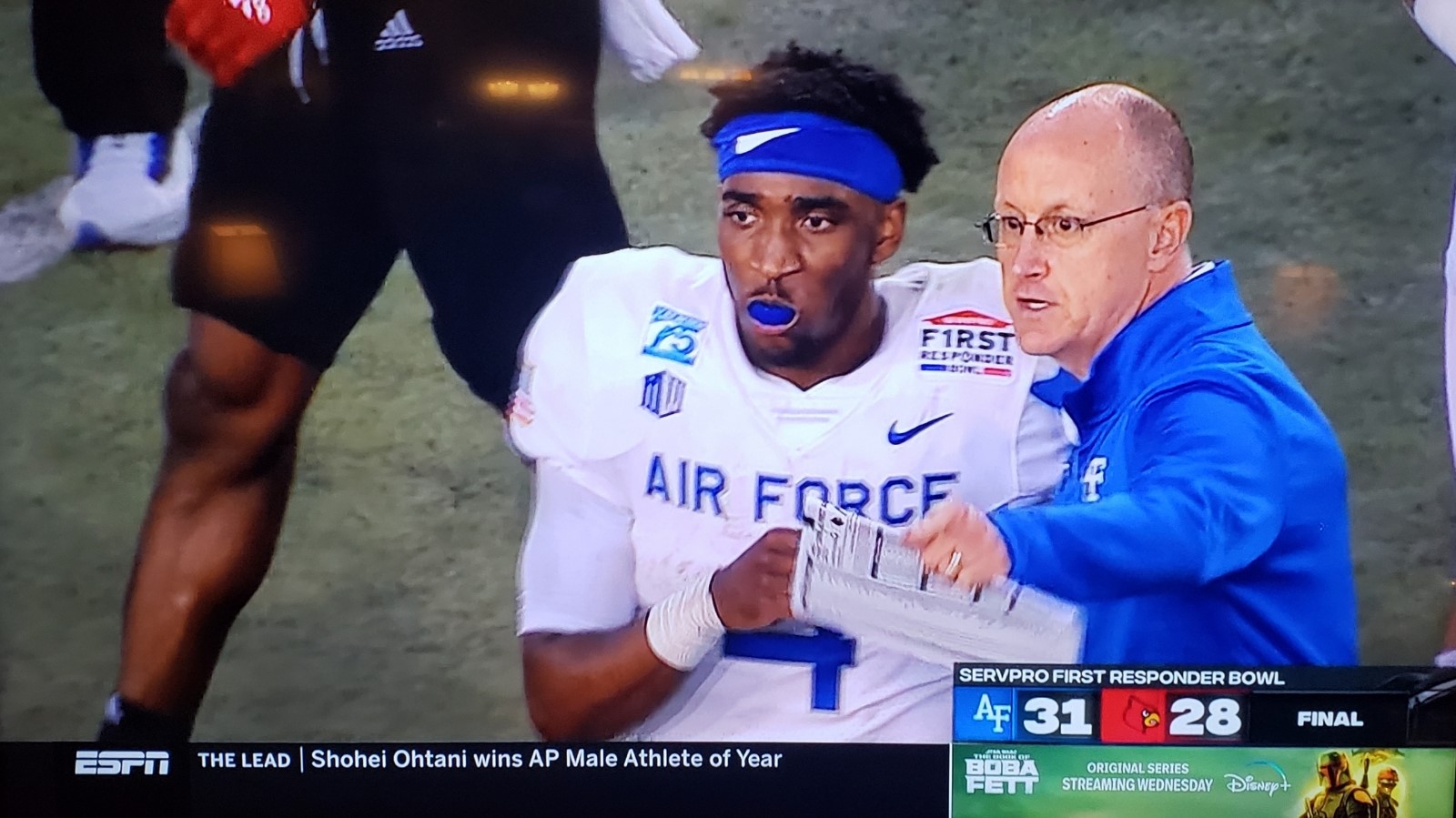 Troy Garnhart with Air Force QB Haaziq Daniels at the 2021 SERVEPRO First Responder Bowl.
Troy Garnhart – United States Air Force Academy (Colorado Springs, Colo.)
Association AD - Communications
What would SIDs at other institutions be surprised about is the most unique aspect of being an SID at a service academy?
Without question, it would be the uniqueness of being a government employee. We work on an active military base, which just happens to have a Division I college athletics program operating on it. The support agencies we deal with are not used to dealing with intercollegiate athletics, which causes some unique challenges that most SIDs don’t face.
What is your most memorable moment being an SID at the academy?
Going to our first NCAA men’s basketball tournament in 2004. I never believed we could accomplish that at a service academy playing in the Mountain West Conference. We played in Denver and shared the floor with North Carolina, losing a close game. That’s not much different than an SID at another school. But then legendary coach Roy Williams saw me outside the locker room on his way to the media room and complemented the spirit and grit our guys played with. He mentioned that he knew our country was in good hands knowing those kids will be defending the nation when they graduate. I have heard that before, but it really resonated with me coming from someone like Coach Williams.
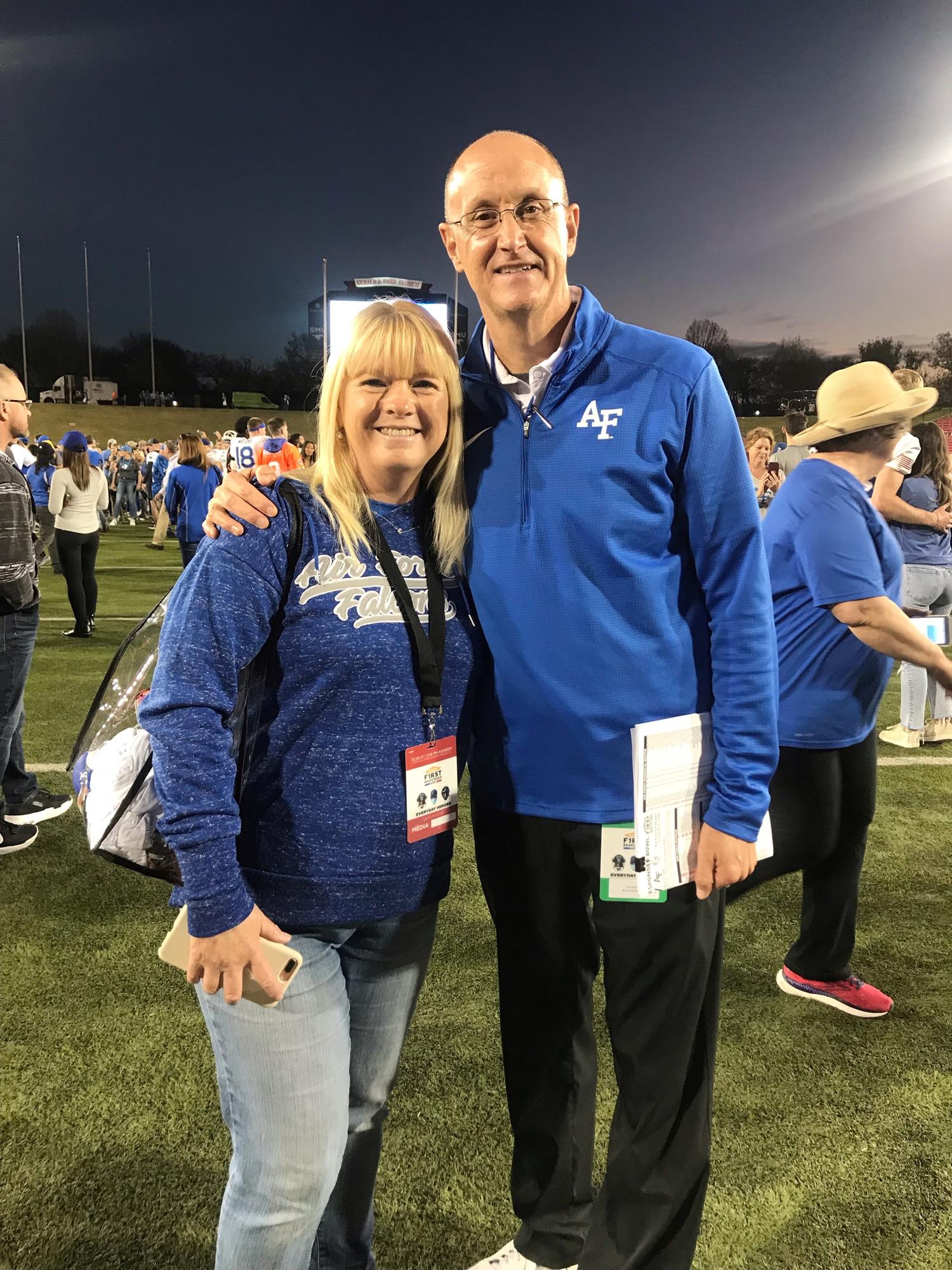 Troy Garnhart with his wife Kim at the 2021 First Responders Bowl
How does your access to student-athletes differ (if it, in fact, does) from other schools?
Different coaches allow different access, but overall, it’s much less than at a civilian school. Cadet-athletes have crazy schedules, often carrying 18-21 semester hours, in addition to mandatory military training, plus other military duties. We try to be very respectful of their time. They are always so willing and helpful, but we often remind them that anything we are trying to schedule should not conflict with any academic or military requirement, practice, weights, film, etc.
As service men and women, do you feel your student-athletes differ in any way from those at traditional colleges and universities? If so, how?
Every school has great kids, so when I say great things about the kind of young people our cadet-athletes are, it can come across the wrong way. I do think the biggest difference is the responsibility service academy athletes accept when they come here. It’s an awesome responsibility for a young person to make a choice to do what’s needed to defend our nation. They may make the ultimate sacrifice for their nation one day. That takes a special young person.
What is your employment status and does that impact your job situation in any way?
Our entire communications staff are government employees. We are subject to the same things as other government employees, especially when it comes to government furloughs and government work stoppages, etc. There are several advantages to being a government employee, however, like cost-of-living raises, credit for time served, etc.
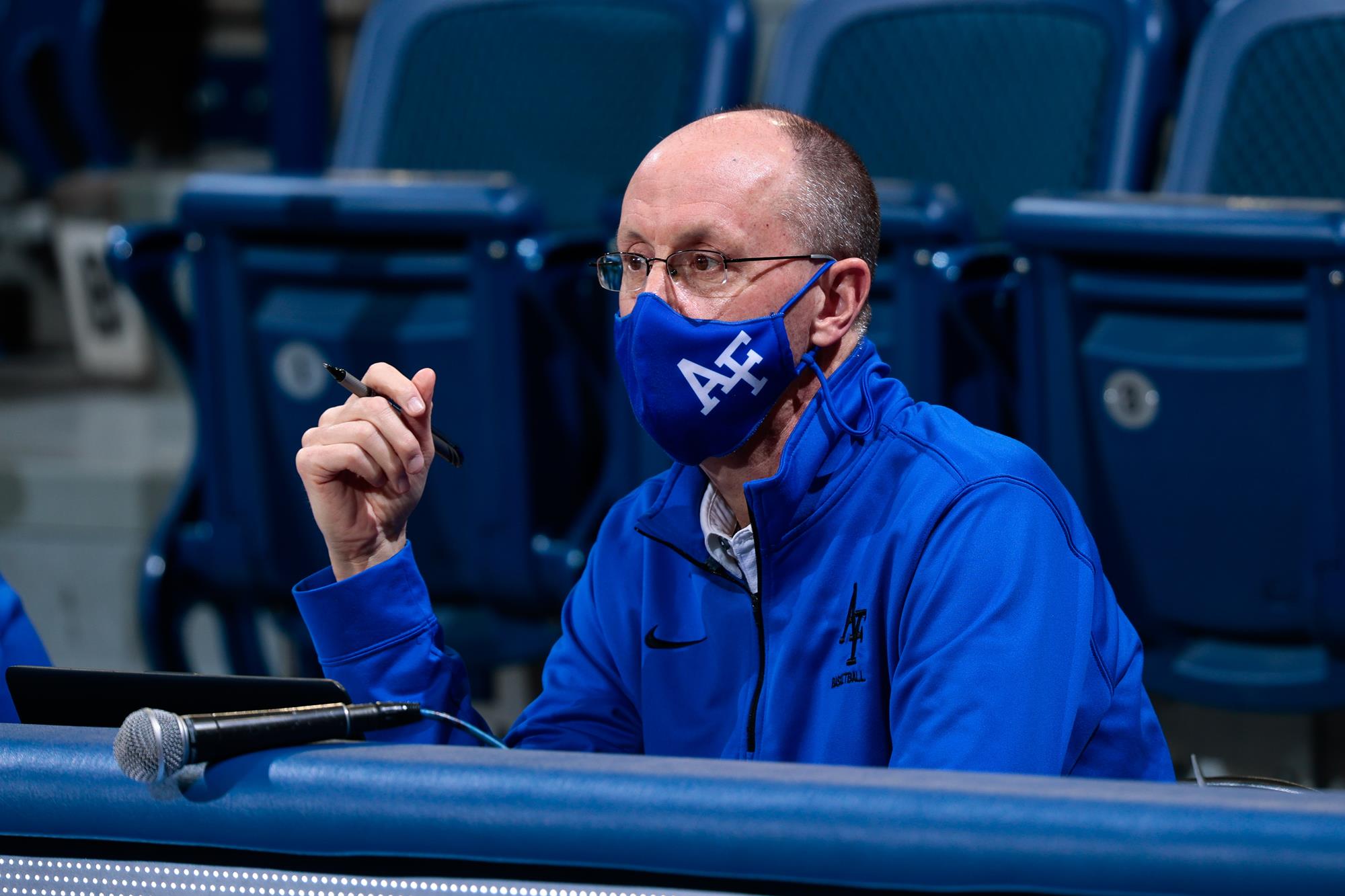 Troy Garnhart at an Air Force basketball game.
Does your access to campus differ from a traditional campus? What is the access process for fans to come to games on campus?
We work on an active military base, so we are required to show our government ID to get on base each day. In addition, when the media comes to an event, we must clear them through our Security Forces unit to get them access to the base. They can’t just show up like on a public campus. It is particularly more difficult when a television network is broadcasting the game. We must supply a schedule of when everyone is coming, schedules for the production truck, the crew, announcers, etc. The trucks come through one gate, while the others come through a different one. It can get a little crazy, but Security Forces does a great job working with us.
How is it when your student-athletes graduate and are commissioned, and you know they may be going out into combat areas as service men and women?
When we hear stories about former athletes becoming pilots or squadron commanders or other prestigious things, it brings a tremendous source of pride to our staff. I have been here for 30-plus years, so I have seen former athletes become generals, university presidents, head coaches, etc.
The most rewarding thing for me is when they come back to visit and stop in to see you. It’s very humbling to know that we played a small role in their success at the Academy. The reverse of that is when you hear about someone being killed in action. Thankfully, it has not happened often, but those days are challenging. I’m comforted at those times that there is such a family atmosphere within the teams that I know people are there for the families.
What has kept you at your academy for so many years?
The people! When you work in athletics and interact with the athletes, it’s tough to think about being at a better place. The athletes are all so respectful and represent us so well. In addition, it takes a special coach to be successful at an Academy. They really understand and respect the mission of producing leaders of character for the Air Force and nation and what that takes. I have a great appreciation for the mission of the Academy and being surrounded by like-minded people makes it a great place to work. Colorado Springs is also an unbelievable place to live. My wife and I are native Coloradoans, so this is our home.
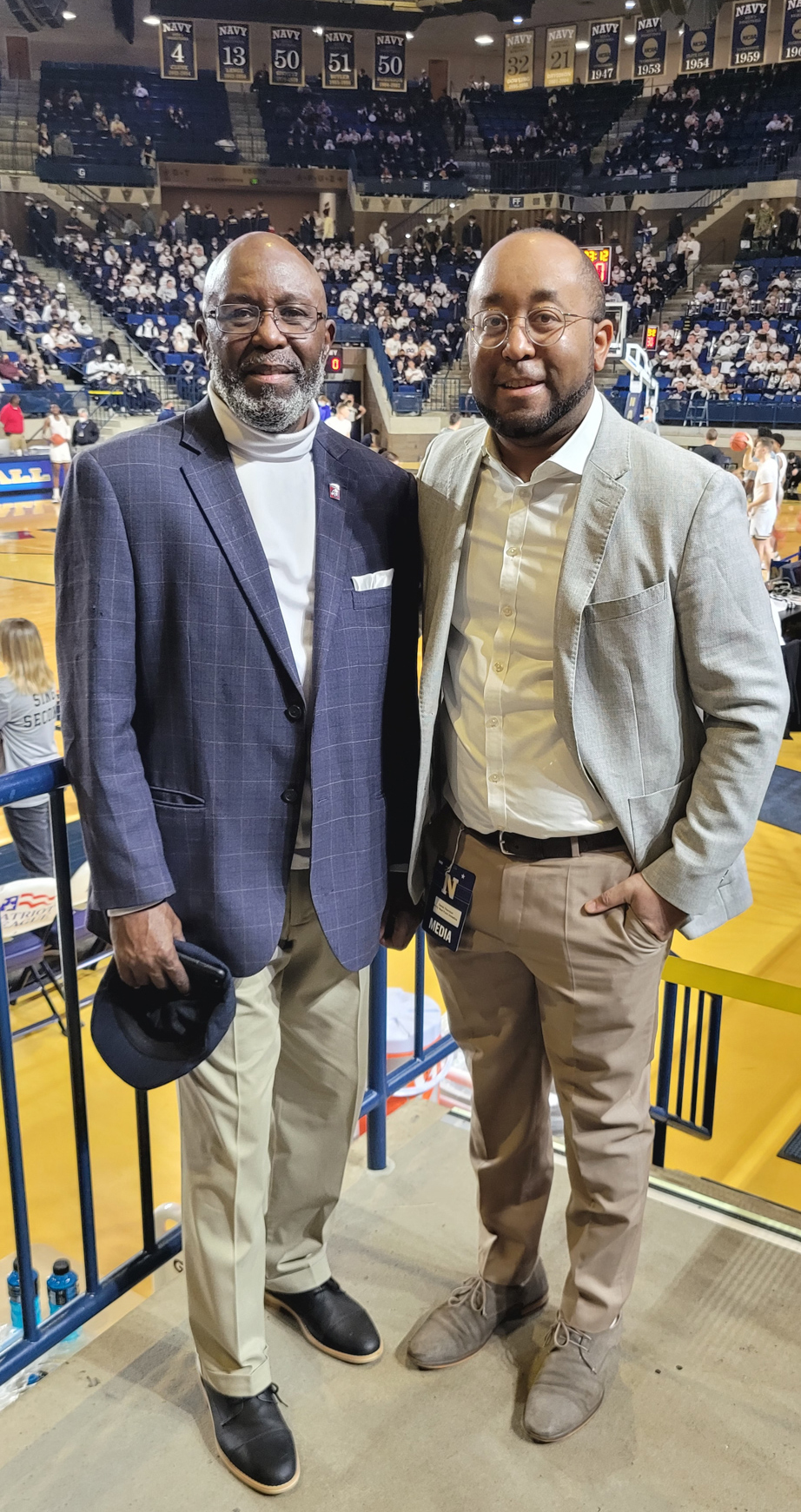 Derick Thornton with his father Tim Thornton at an Army-Navy basketball game.
Derick Thornton – United States Military Academy (West Point, N.Y.)
Assistant A.D. - Athletics Communications
What would SIDs at other institutions be surprised about is the most unique aspect of being an SID at a service academy?
I think the most unique aspect is “who” is watching your work, like high-ranking military officials. You also have to be aware of national and global issues that may affect our military servicemen and servicewomen in which we do receive guidance and messaging for Army Public Affairs.
Our external unit, particularly our communications and marketing staffs, work closely with our Public Affairs Office (PAO) at the Academy so we are in alignment with our messaging across all channels. There are times when we have to get approval from PAO about what we can and cannot post. We also work through them to set up interviews with Cadets when they are in their OCP (Operational Camouflage Pattern) uniforms and when external media do stories on Cadets near the academic buildings.
Also, the amount of dignitaries from across the armed forces and around the world and celebrities that attend events at West Point.
What is your most memorable moment being an SID at the academy?
I have a couple during my brief time at the Academy. I grew up watching the Army-Navy football game and it has always been a bucket list item to attend so having the chance to work the game in 2021 at MetLife Stadium (Giants fan here!) was a memorable experience.
The other one that comes to mind is when our men’s basketball team rallied from a 27-point deficit to beat our rival Navy in Annapolis. It is the sixth-biggest comeback win in NCAA Division I men’s basketball history. I have never been a part of a game like that. The team showed great grit and determination. My dad, an Army vet, was in attendance and it was his first time going to an Army West Point athletic event. He told me how proud he was of the team.
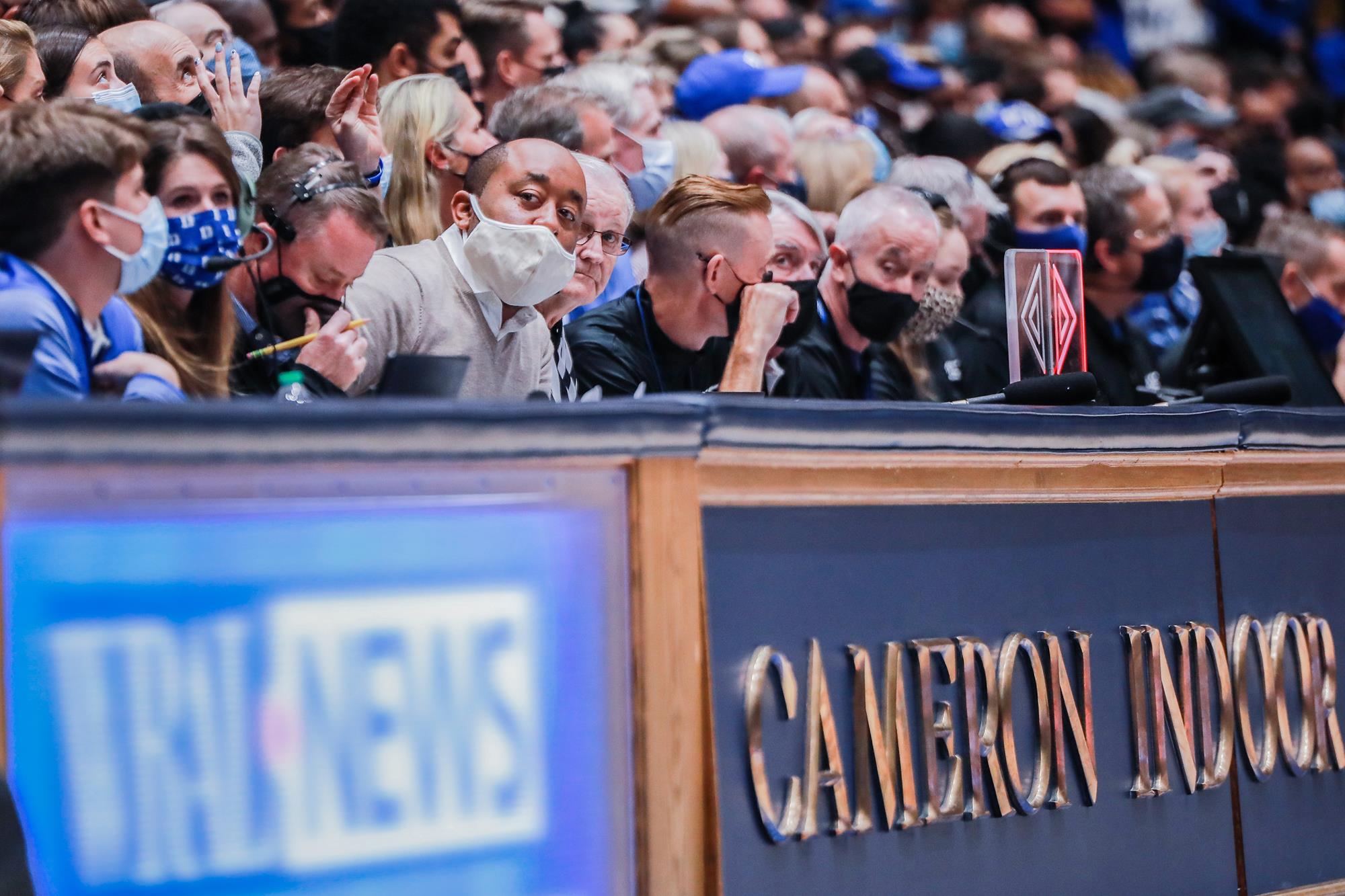 Derick Thornton working an Army basketball game at Duke.
How does your access to student-athletes differ from other schools?
I believe student-athletes on every level have a time-consuming schedule. That being said, the Cadet-Athletes’ schedules are not only compact but demanding. I remember years ago looking at a graphic with a Cadet’s schedule and thinking to myself “wow”. Everything was scheduled to the minute from formation, class, lunch, practice, study hall, lights out.
Now, I have first-hand experience working with our Cadets when scheduling interviews that fit into their schedules. They are very accommodating and willing to do what it takes to make time for me and the media, regardless of how little “free” time they have. As for my office, we do not have student assistants from the Academy but we do try to recruit students from neighboring institutions.
As service men and women, do you feel your student-athletes differ in any way from those at traditional colleges and universities? If so, how?
The best thing about this job is working with our Cadet-Athletes. I have had the pleasure of working with many student-athletes throughout my career and they all have been great. At West Point, I’m truly amazed by the respectfulness, appreciation, and gratitude that they demonstrate not only to me but to administrators, support staff, media members, etc. The Cadet-Athletes are extremely mature and handle themselves so well. The Cadet-Athletes are truly special people.
What is your employment status and does that impact your job situation in any way?
I am employed by the Army West Point Athletic Association (AWPAA) which is a non-profit organization that supports our 30 athletic programs.
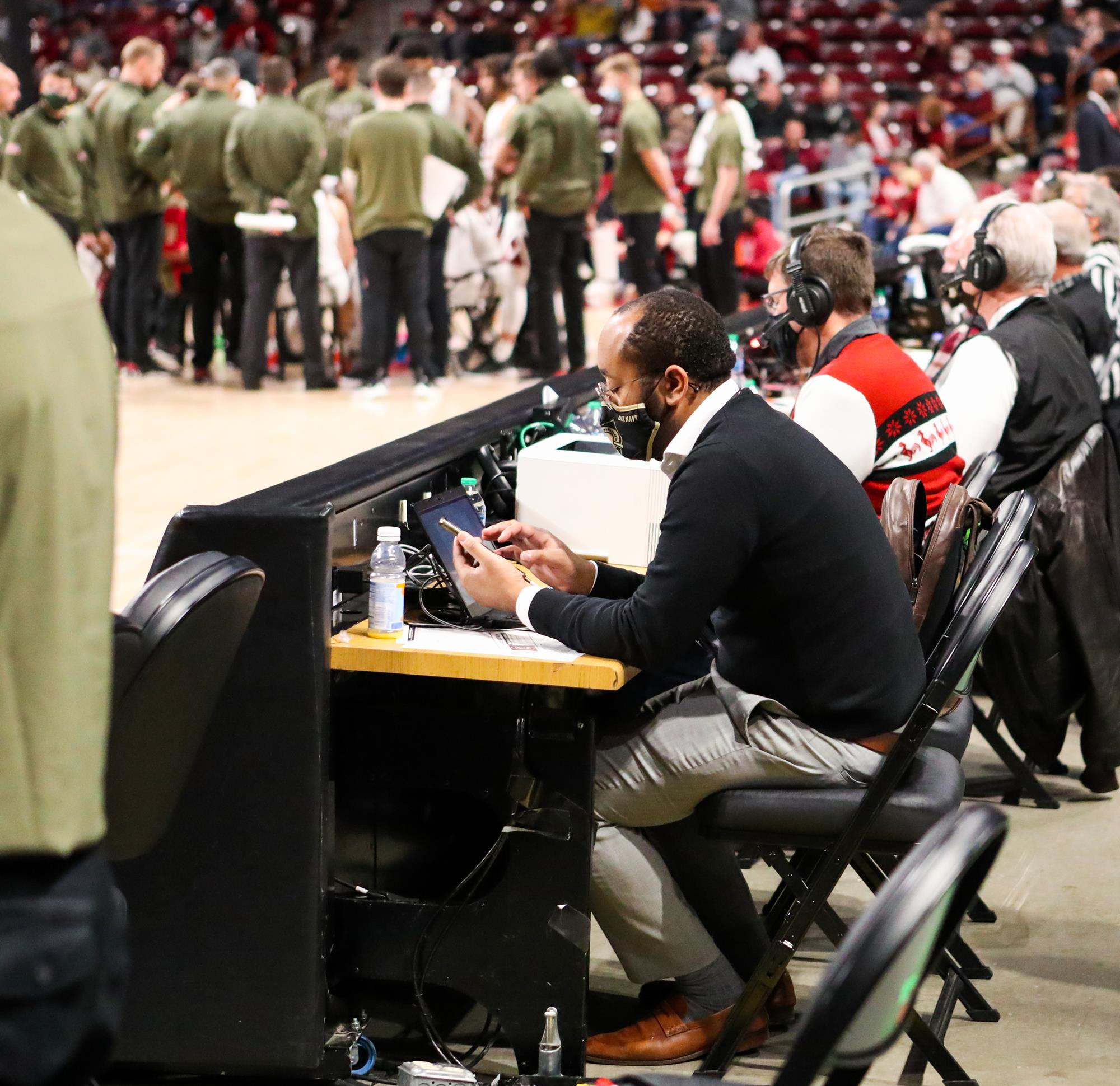 Derick Thornton on press row at an Army game.
Does your access to campus differ from a traditional campus? What is the access process for fans to come to games on campus?
One thing people may not know is that West Point is an active military installation and security is at the foremost. You need to have access to enter certain facilities, including arriving on Post itself. You go through multiple levels of background checks to receive your CAC (Common Access Card) which then allows you access. When people come to Post, including the media, they have to go to the Visitor’s Center first to be screened before being admitted on Post. On game days, there is some flexibility, especially on football gamedays.
How is it when your student-athletes graduate and are commissioned, and you know they may be going out into combat areas as service men and women?
It is a reminder of the commitment these young men and women have made to serve this country. They attend West Point knowing they will receive an excellent education and superior military training while playing their sport at the NCAA Division I level. Then, they turn their attention to their military obligations as an officer. These impressive men and women are ready to lead our soldiers after their 47-month experience at the preeminent leadership institution.
What attracted you to your academy position? What has surprised and/or impressed you the most about your ‘new’ job?
What attracted me to Army West Point is my connection with the US Army. I’m a son of an Army Officer and I grew up on military posts in Germany and throughout the United States so when I see the commissary (grocery store), the Exchange, the schools, the hospital, and the housing neighborhoods on Post here, it reminds me of my childhood. I have always followed Army West Point athletics and when this opportunity presented itself, I wanted to do my part in sharing and telling the stories of the Cadet-Athletes at West Point.
The thing that has impressed me the most is the passion for Army West Point athletics by our fans and supporters. As America’s Team, we have fans across the nation and the world. When we travel to games, there is usually a sizable fan contingent especially if we are playing near an Army post.
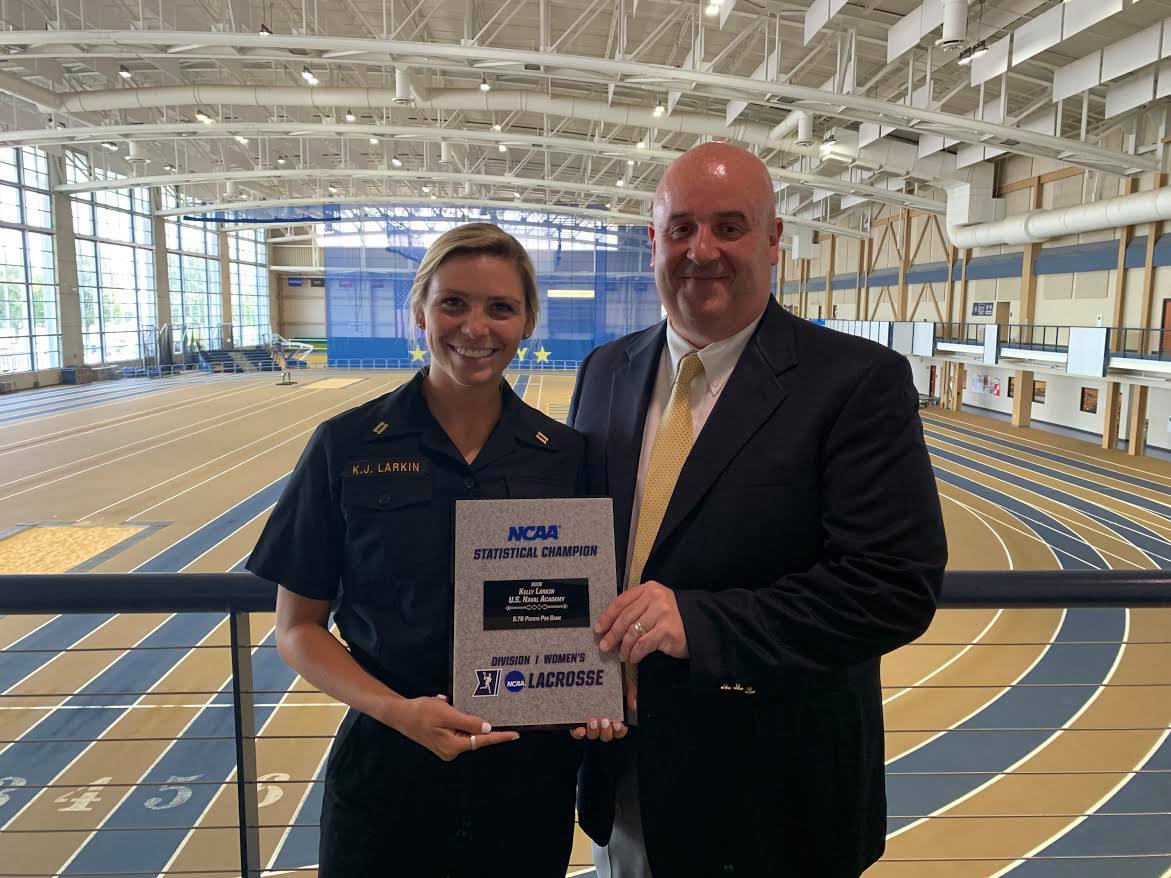 Scott Strasemeier with Navy Lacrosse player Kelly Larkin.
Scott Strasemeier – United States Naval Academy (Annapolis, Md.)
Senior Associate A.D. / Communications
What would SIDs at other institutions be surprised about is the most unique aspect of being an SID at a service academy?
Maybe the biggest surprise is that it’s no different than at any other school. We run our department just like every other Division I school. The best thing about the job is seeing the transformation of our student-athletes from young plebes (freshmen) to their senior year when they are preparing to go off and serve our country in the Navy or Marine Corps. We are fortunate in that when we set up an interview, we know that the student-athlete will not only show up, but will show up early and will be a great interview. When it comes to varsity athletics though, we are as competitive as any school in the country. We expect to win in every sport and the expectation is to run the best SID office in the country. I guess one difference is that we don't have any student assistants to help with our 33 varsity sports (which is more than the other two Academies, Air Force has 27 and Army 28)
What is your most memorable moment being an SID at the academy?
There are so many having been here for 31 years. But No. 1 is 2007 beating Notre Dame in South Bend and ending the long losing streak. We’d not beaten them since Roger Staubach’s senior year in 1963. It was 46-44 in triple overtime. We had to stop a two-point conversion twice as Notre Dame got a pass interference call in the end zone and got another chance. We stopped them again and stormed the field. Every time we Beat Army is a great memory. We’ve won a lot more than we’ve lost in my time. But it’s hard to top that Notre Dame game due to its historical nature.
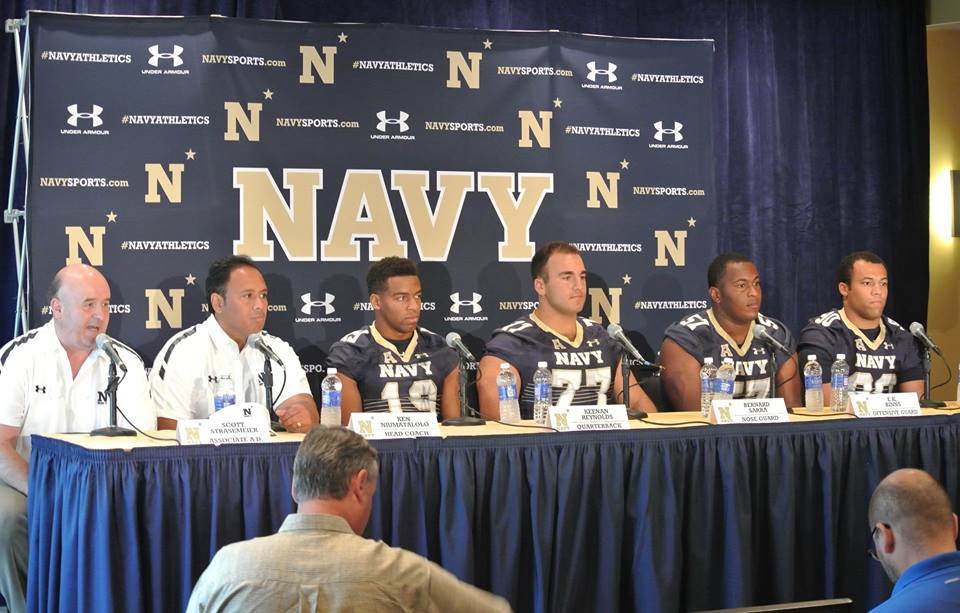 Scott Strasemeier conducting a Navy football press conference.
Does your access to student-athletes differ from other schools?
Not really, though our student-athletes don't have a ton of free time. They’re taking 18 to 20 credit hours but there’s usually time in the day to get someone for an interview. We don’t do interviews at night, just around their free periods during the day. We do request the media give us 24 hours advance notice to make sure the student-athletes are available.
As service men and women, do you feel your student-athletes differ in any way from those at traditional colleges and universities? If so, how?
They’re still 18 to 21 year-olds. Even though they’re at Navy, they’re still young adults. You still have to remind them about things or work with them if they are going to do an interview about a certain topic just like any college age student. In general though, they’re very responsible. It’s a smart group of people we’re around. It certainly keeps me young since the ages of the people we’re dealing with never change. That’s the unique part of college athletics.
What is your employment status and does that impact your job situation in any way?
The Naval Academy Athletic Association is a 501c3 and that is who we are employed by, not the government. We run the athletic department like you do any other athletic department. Air Force and Army recently have gone to the Navy model, but they still have some government crossover.
Does your access to campus differ from a traditional campus? What is the access process for fans to come to games on campus?
When I got here in 1991, anyone could drive on to the Academy grounds just like any other campus. After 9/11, things locked down. Now, to be able to drive on academy grounds, you have to have a Department of Defense ID, so that’s one of the biggest challenges. Fortunately, football, men's and women's lacrosse and baseball are off campus, but the rest of the sports play on campus so when we have a home basketball game on television we have to get forms filled out by 40-50 people for TV and they have to pass a background check. It ends up being a ton of extra work. Everyone understands we are a military base as well as a university. There are rules we have to go by set forth by Naval District Washington. We are treated no differently than Fort Meade for example in terms of access.
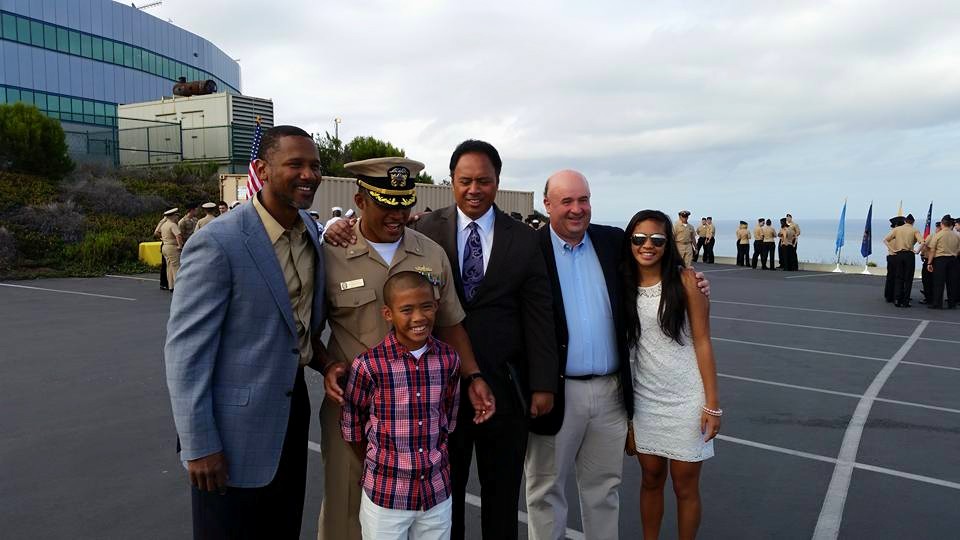 Scott Strasemeier with coach Ken Niumatalolo.
How is it when your student-athletes graduate and are commissioned, and you know they may be going out into combat areas as service men and women?
Commissioning is definitely the most rewarding date of the year in my opinion. To see the young men and women you've worked with for the past four years graduate from a prestigious university and know what they’re going to do in the future gives me chills every single time.
The most rewarding thing about this job is hearing from former student-athletes who are now out protecting our freedom all over the world. Every single person is doing something unique and awesome, it’s definitely special. Our coaches hear from people who are up at three in the morning to watch or listen to a Navy lacrosse game. That’s special to me. Plus, knowing some stories I can’t even tell that former student-athletes have been involved in is pretty cool.
What has kept you at your academy for so many years?
My staff, I’ve been very lucky to have the best assistants in the country. Stacie Michaud and Justin Kischefsky have both been with me for 25 years now. Alex Lumb and Mark Leddy for over a decade. So I’ve been able to keep a great staff almost the entire time with very little changeover. The general athletic staff is great to work with. I’ve been here 31 years and only had two athletic directors in Jack Lengyel and Chet Gladchuk. You couldn’t ask for any two better ADs to work for.
People tend to stay here, it’s not just me, because it's a great place to live and work. We’ve only had four baseball coaches in the last 60 years. There have been four football coaches and four men’s basketball coaches in my 31 years. We have great people, great coaches and great student-athletes.
Another cool thing is the Army-Navy competition in all sports. There’s nothing like it. It’s the greatest rivalry in all of sports. I’ve been to the Super Bowl, the World Series, the NBA Finals. There is nothing like Army-Navy, and it’s not close. The way things are going with college athletics, Army, Navy and Air Force are going to be the last of true amateur athletics.
Talk about these stories on the
CoSIDA Slack Community.